The Feature / Collections
Bentley Press Plate Collection
Plates mentioned
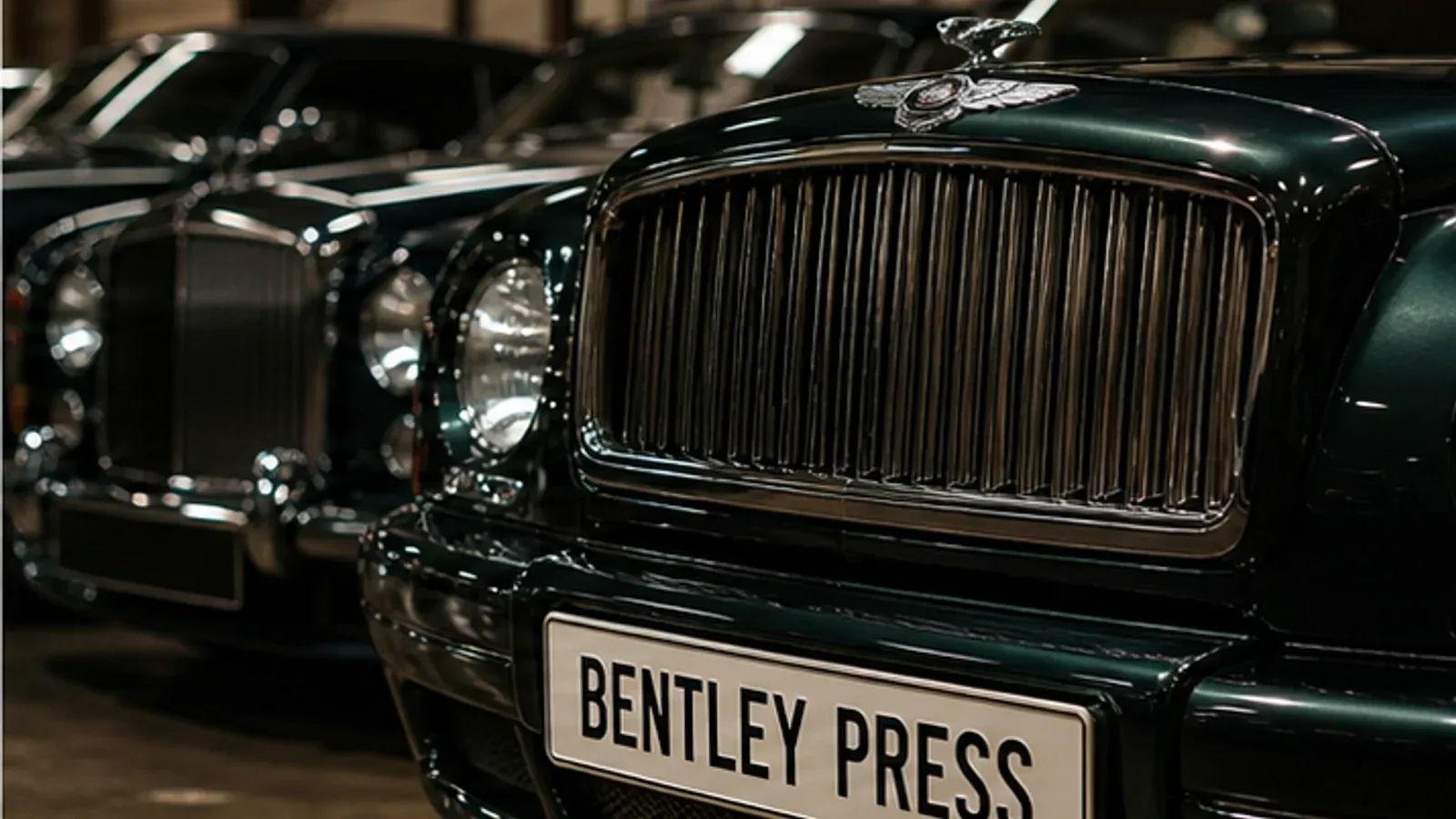
Inside Bentley’s Number Plate Collection: A Closer Look at The History of A British Manufacturer There are very few invitations in the world of private number plates that carry genuine weight. Being welcomed into Bentley Motors’ legendary press plate collection is one of them. Crewe is already hallowed ground for anyone who appreciates British automotive craftsmanship, but tucked within the history of this iconic manufacturer is a story that most number plate enthusiasts never get to hear up close. Bentley kindly extended an invitation to explore that collection, and what followed was one of the most remarkable deep dives into the intersection of motoring heritage and cherished registrations you are ever likely to encounter. More Than a Marketing Tool Most people familiar with the private plate industry will know that manufacturers occasionally use personalised registrations on press cars. What Bentley has built, however, goes considerably further than that. With over 80 private plates in their collection and more than 100 transfers completed every single year, Bentley operate one of the most sophisticated and deliberate number plate strategies of any manufacturer in the United Kingdom. They are among a select group of car makers who use private registrations not just incidentally, but as a structured and considered part of how they present their vehicles to the world. Crucially, this is not random. While the precise formula remains confidential, Bentley carefully align their registrations with the specific model of car being shown. Every plate assigned to a press vehicle has been thought through. When you watch a Bentley commercial or see a press image, the number plate in shot is almost certainly chosen with intention. The result of decades of this approach is something quite remarkable: certain registrations, particularly those featuring the Chester area code TU, have become so associated with Bentley that owners as far afield as overseas have sought to replicate them on their own cars. A private number plate, in other words, has become part of the brand identity itself. The WO Legacy At the heart of the collection sit the WO plates, and for good reason. WO is the Monmouthshire county identifier, but for Bentley, those two letters carry a significance that goes far deeper than geography. Walter Owen Bentley, the founder of the company, is universally referred to within the marque simply as WO. His initials have become shorthand for everything the brand stands for: engineering integrity, endurance, and an uncompromising pursuit of performance. The crown jewel of the entire collection is 1 WO . It is, by any measure, one of the most desirable private plates in Britain for a Bentley collector, even if its value is almost impossible to pin down with precision. A plate of that provenance and cultural resonance, attached to one of the most storied names in motoring, would almost certainly command well into the hundreds of thousands of pounds at auction. For context, its original issue counterpart, WO 1 , a Monmouthshire registration dating to 1927, sold for £216,000 in 2024. The two plates are different animals entirely, but that sale gives a reasonable indication of the appetite for WO registrations among serious collectors. Bentley have been entirely clear on one point: none of their plates will ever come to market. The collection is not for sale, and it never will be. Alongside 1 WO , the collection includes 11 WO , 12 WO , 19 WO , and 21 WO , a group of dateless registrations that, taken together, form a remarkable set. The Story of 1900 TU If 1 WO is the headline, then it’s TU plates are a story that number plate enthusiasts will likely associate with the manufacturer. Their TU registrations have become famous through their marketing and PR, to the extent that Bentley owners overseas have replicated these distinctive marks. A standout is 1900 TU , a registration that belongs to the very first Bentley T Series ever produced, chassis 0001 of the 1868 cars ever made. From the beginning, this car was used for press and promotional work, and at birth it was assigned 1900 TU . It subsequently wore 85 TU for a period before it was placed into storage, where it remained untouched for a very long time indeed. When the car was eventually rediscovered under a tarpaulin, the significance of what had been sitting in that warehouse became immediately apparent. It was returned to the fold and handed to P&A Wood, one of the most respected Bentley specialists in the world, for a sensitive restoration. Once that work was complete, 1900 TU was reissued to the car, restoring it to the state it had been in at its very beginning. Alongside 1900 TU , the collection includes 20 TU , 1200 TU , 1800 TU , and 2000 TU , 3500 TU , a group of dateless registrations that, taken together, form a highly distinctive set. It is the kind of provenance story that makes a number plate far more than just a combination of letters and numbers. The registration and the car are inseparable, each one giving meaning to the other. The BML Collection and Beyond Alongside the dateless WO and TU plates, Bentley hold an extensive collection of prefix format registrations carrying the identifier BML, Bentley Motors Limited, as well as a complete run of current style BY plates from BY03 BML through to BY24 BML . Here, the year identifier is tied to the year that the specific car was produced. The prefix BML plates span a wide range of year letters, from C through to Y, covering the entirety of the prefix era from 1983 to 2001. Numbers such as 10, 14, 16, 18, 40, 44, 55, and 60 appear repeatedly across different year letters, suggesting these figures hold particular relevance within Bentley’s internal logic, whether tied to engine specifications, model numbers, or other markers of significance within the marque’s history. A small number of unique plates also sit within the collection: VER 45 , BA64 LAR , B22 TUR , and BA11 TUR , each one a personalised abbreviation of the car’s model name. Taken as a whole, the collection reads like a timeline of British number plate history, moving from the dateless era through prefix format and into the current style system, all anchored to the Bentley identity. When Rolls-Royce Plates Became Bentley's To understand why certain registrations in the collection carry a history that predates Bentley Motors Limited as we know it today, you have to go back almost a century. In 1931, Rolls-Royce purchased Bentley Motors, which was in receivership at the time, through a front company called British Central Equitable Trust. W.O. Bentley himself did not know the identity of the buyer until the deal had been completed. From that point on, the two marques operated under the same corporate roof, sharing the same factory, the same ownership, and in many cases, the same press fleet. That arrangement endured for decades, until Vickers sold the combined business to Volkswagen Group in 1998 for £430 million. The Rolls-Royce brand name, however, was controlled separately by the aero-engine maker Rolls-Royce plc, which chose to license it to BMW. From 1 January 2003, the Crewe factory became solely Bentley Motors Limited, with Rolls-Royce production relocating to a new facility in Goodwood. Bentley is, in every meaningful sense, the direct corporate successor to the original combined business. That included the number plates. Registrations accumulated under Rolls-Royce Motors ownership did not disappear when the brands separated. They remained in Crewe, and Crewe became Bentley. A plate like 100 LG , which originated under Rolls-Royce ownership, found itself folded into what is now Bentley's collection by virtue of that corporate continuity. It was never sold or transferred in the conventional sense. It was simply already there. The name above the door changed in 2003; the plates did not. For a number plate enthusiast, there is something rather compelling about that. A registration that once represented one of the most revered names in motoring now sits quietly within a collection that carries an equally storied legacy, serving as a tangible link between two brands that shared far more history than most people realise. Why This Matters for the Private Plate Industry Bentley’s approach to number plates offers a genuinely interesting lens through which to think about private registrations more broadly. For most plate owners, the motivation is personal. A name, an age, a set of initials. For Bentley, the motivation is both personal and commercial, using registrations to reinforce brand identity, create continuity across decades of press material, and in some cases, elevate the vehicle itself. The fact that their strategy has influenced buyers in other countries, prompting them to seek out TU registrations to echo the Bentley aesthetic, is a remarkable demonstration of just how powerful a well chosen number plate can be. It also raises a question that is worth sitting with for a moment. If a single dateless registration tied to a marque’s founder can command north of £200,000 at auction, and if Bentley’s own 1 WO is considered beyond price entirely, what does that tell us about the long term value of plates with genuine, documented heritage behind them? The answer, for anyone who works in or around the private plate market, is probably already clear. A sincere thank you to Bentley Motors and Bentley Newsroom for their generous time and access in making this possible. C1 BML C2 BML C12 BML C14 BML C16 BML C18 BML G10 BML G16 BML G18 BML W14 BML W15 BML W17 BML W40 BML W44 BML W55 BML W60 BML W66 BML W100 BML W600 BML K40 BML K50 BML T44 BML J55 BML V66 BML V44 BML N40 BML N44 BML N50 BML N55 BML R55 BML R44 BML T40 BML T44 BML T55 BML T60 BML T66 BML X14 BML X44 BML X55 BML X60 BML X66 BML P10 BML P40 BML P44 BML P55 BML Y10 BML Y11 BML Y14 BML Y15 BML Y16 BML Y17 BML Y44 BML Y55 BML V55 BML BY03 BML BY04 BML BY05 BML BY06 BML BY07 BML BY08 BML BY09 BML BY10 BML BY11 BML BY12 BML BY13 BML BY14 BML BY15 BML BY16 BML BY17 BML BY18 BML BY19 BML BY20 BML BY24 BML 100 LG VER 45 BA64 LAR B22 TUR BA11 TUR 20 TU 1200 TU 1800 TU 1900 TU 2000 TU 3500 TU 1 WO 11 WO 12 WO 19 WO
21 WO